


24 November 2026
Ahead of crucial EU fisheries vote, BLOOM exposes the destruction wrought by industrial fishing to the European Parliament
Ahead of a crucial vote in the European Parliament on the future of EU fisheries funding, BLOOM has warned lawmakers against proposals that could weaken safeguards against overfishing and reopen public support for destructive industrial fishing practices. The warning comes as negotiations intensify regarding the next generation of EU fisheries funding under the 2028-2034 EU budget. On 3 December, Parliament’s Fisheries Committee (PECH) is expected to vote on rules that will determine how billions of euros of public funding are spent across the sector.
On Monday night, at an event inside the European Parliament in Strasbourg, co-hosted by MEPs Emma Fourreau (The Left), David Cormand (Greens/EFA), Mélissa Camara (Greens/EFA) and Jean-Marc Germain (S&D), BLOOM presented its new documentary The End of Ogres. The screening was followed by a discussion with Frédéric Drogerys, who spoke of his experience as a fisher, BLOOM’s founder Claire Nouvian, and MEPs addressing the urgent need to align EU spending with its environmental, climate and social commitments and to support a transition away from destructive fishing towards a fairer future for coastal communities and marine ecosystems.
BLOOM therefore calls for 50% of EU fisheries funding to be allocated to marine conservation, restoration, control and data collection, and the remaining 50% to support small-scale coastal fishers and the transition towards low-impact fishing, including the permanent cessation of 33m+ mega-industrial vessels.
Watch BLOOM’s documentary: “The End of Ogres”
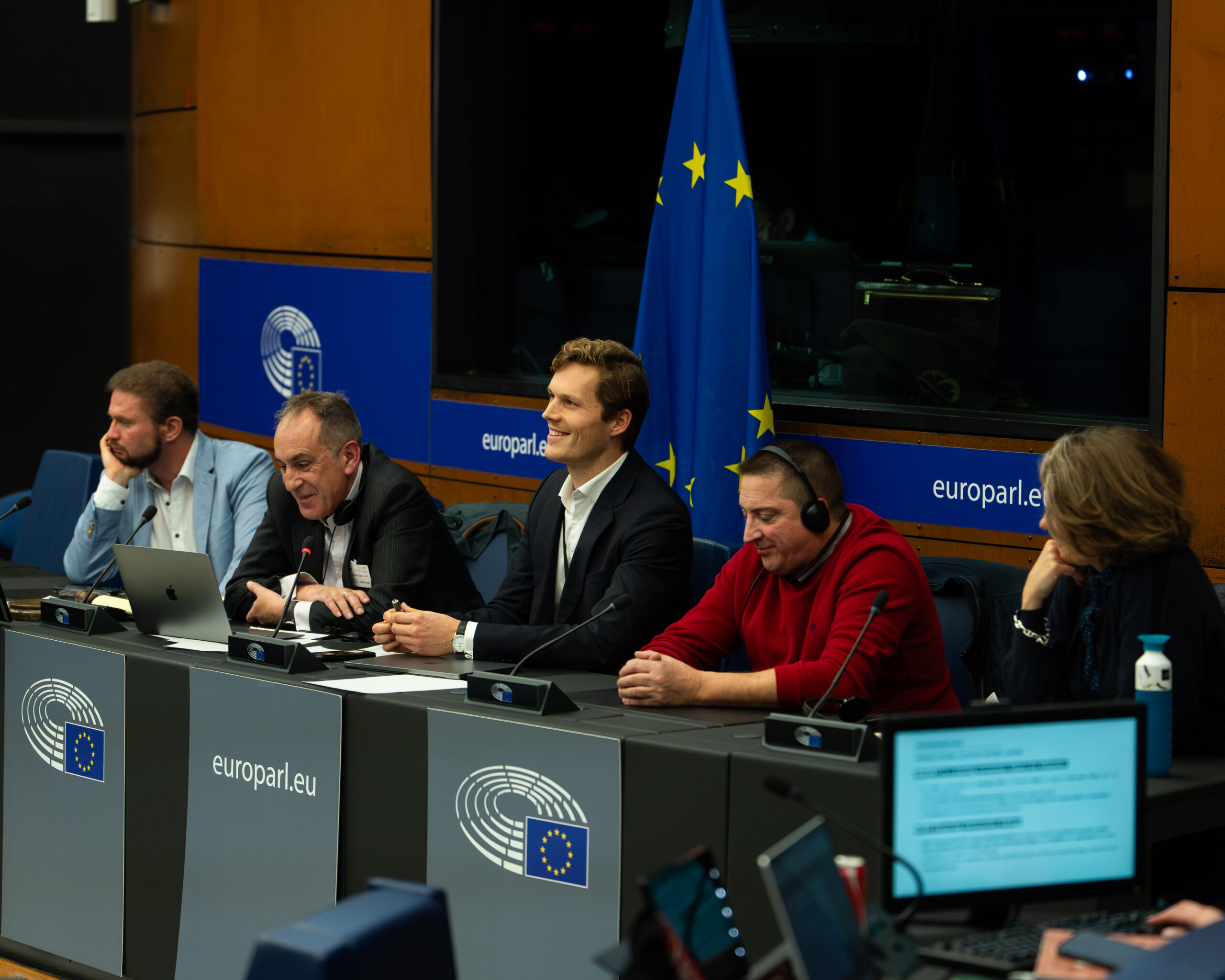
As Claire Nouvian, founder of BLOOM, said: « Industrial lobbies that meet with decisionmakers in Brussels and in capitals and present themselves as « fishers » aren’t. They usurp that name as they actually represent only 1% of oligarchs that speculate on fish and have nothing in common with what fishing means for everyone : the action of catching fish for human consumption, being tied to a territory, contributing to a local economy. The 1% of mega-industrial ogre vessels over 33 metres in length actually fish at an average distance of 4000 km from their port of registration. Their size, by essence, makes them predatory of resources and a direct competitor for 99% of European fishers. The Parliament can decide to stop the ravages these monster trawlers cause once and for all by allowing funds to dismantle them. That would give the EU fishing sector and oceans a chance to regenerate and break free from the mega-industrial fishing ogres and their unacceptable social, environmental and democratic impacts ».
The human and environmental cost of industrial fishing
Through striking images, testimonies from fishers and contributions from leading marine experts, including Professor Callum Roberts, the documentary exposes the devastating consequences of industrial fishing for marine ecosystems and coastal communities.
From the decline of local fishing communities and the closure of fish auction halls to the destruction of marine life by industrial fleets, the film reveals the human cost of a model that has received decades of public support. Fishers describe the growing difficulties of maintaining their livelihoods as industrial fishing places increasing pressure on marine resources, while scientists explain why current practices threaten the long-term survival of fisheries themselves.
The documentary also shows that another future is possible. By ending support for the most destructive practices and helping small-scale, low-impact fishers, Europe can protect marine ecosystems while preserving jobs and coastal economies.
Following the screening, MEP Jean-Marc Germain (S&D) described the scale of the problem: “I eagerly await the word that will replace ‘fishing’ to describe the activity of these floating factories, because this is industrial destruction of the resource.”
Watch BLOOM’s documentary: “The End of Ogres”
33 metres: a concrete proposal to end mega-industrial fishing
At the centre of BLOOM’s campaign is a scientifically grounded proposal: phase out the 638 European fishing vessels measuring 33 metres or more by 2035.
These vessels represent just 1% of the European fleet, yet account for a disproportionate share of the sector’s environmental damage.
Such mega industrial vessels support ten times fewer jobs per tonne of fish landed than fleets using low impact passive fishing gear, but receive seven times more subsidies per job than small scale coastal fleets.
BLOOM is calling for funding a mandatory permanent cessation scheme for such mega-industrial vessels with support to workers affected as part of a package that funds a transition to sustainable fishing, support for small-scale, low-impact fisheries and marine restoration.
MEP Emma Fourreau (The Left) sent a message of support: “We cannot claim to defend small-scale fishers while subsidising mega-industrial fleets that destroy the ocean and threaten their livelihoods. It is time to redirect public subsidies toward small-scale fisheries, the marine environment and a real social-ecological transition in fisheries.The 33-metre measure offers a concrete path to end this injustice.”
Europe’s next fisheries budget: the danger is imminent
The event comes at a critical moment for the future of EU fisheries. As negotiations advance on the next Multiannual Financial Framework (MFF) for 2028–2034, the European Parliament’s Committee on Fisheries (PECH) is expected to vote on 3 December on the fisheries-specific regulation that will determine which activities can receive European public funding and under what conditions.
Raphaël de Wael, EU policy officer at BLOOM, stated: “Analyzing 30 years of EU public spending to the fishing sector shows that we have failed to protect the ocean but also fishing jobs, ports, coastlines and food sovereignty. The Parliament has a chance to correct this now and use public funds to support the European fishing sector and our most precious ecosystems instead of destroying them. The time is now, and it might be the last chance for small-scale fishers who face an existential threat of disappearing, literally.”
The direction of the negotiations is frightening. On 29 September, EU fisheries ministers adopted a partial negotiating position that would reopen public support for investments in new fishing vessels, reversing restrictions introduced almost two decades ago.
Within Parliament, amendments tabled in PECH to the fisheries-specific regulation by the EPP and other groups on the right risk further weakening safeguards against overfishing, destructive fishing practices and environmental harm. Several proposals would allow subsidies for new fishing vessels and engines without strict conditions on fishing capacity or environmental impact, remove the requirement to balance fishing capacity with available fishing opportunities, and extend public funding to cover up to 100% of investments in fleet renewal and other activities.
Other amendments would prioritise support for the sector’s operating and productive activities, including energy costs and compensation for lost income, while undermining the application of the Do No Significant Harm principle to fisheries funding. Meanwhile, marine conservation, restoration, and small-scale coastal fishers would remain without dedicated funding or mandatory spending targets.
On the positive side, amendments from the minority Left and Green groups, would strengthen the link between EU fisheries funding and climate, biodiversity and environmental goals. They would also support marine protection and restoration, the transition away from towed gears, and the exclusion of support for vessels using destructive fishing methods.
Emma Fourreau (The Left) has proposed a mandatory permanent cessation scheme for vessels above 33 meters. A critical measure as suggested above. In addition, an amendment by Isabella Lövin (Greens/EFA) would ensure 50% of fisheries support would go to small-scale coastal fishers and the transition towards low-impact fishing, and 50% would go to marine protection, restoration, control and data collection.
Amendments from Renew, The Left and Greens that strengthen compliance with the WTO Agreement on Fisheries Subsidies prohibit support linked to illegal, unreported, and unregulated fishing and fishing on overfished stocks and are also welcome.
However, these groups form a minority in the 27-member Fisheries Committee. BLOOM therefore is concerned about the possible use of a Parliamentary procedure which, if not blocked, could allow the Committee with a history of backing industrial interests to open negotiations with the Council without a full plenary vote on its legislative report. Such a move would limit the opportunity for the Parliament as a whole to scrutinise and amend rules that will shape European fisheries funding for the next seven years.
This is particularly important as PECH risks ignoring an Opinion Report adopted in July by the much larger Environment Committee (ENVI) which supports stronger environmental safeguards, marine restoration, small-scale and low-impact fishing, the need to transition away from the most harmful practices, and the exclusion of subsidies contributing to overcapacity, overfishing or illegal fishing.
At stake is whether European taxpayers will continue subsidising fuel-intensive mega industrial fishing or help finance a transition towards a more sustainable and socially fair fishing sector.
As MEP David Cormand (Greens/EFA) warned during the event:
“Everything we have discussed tonight comes down to one idea: a budget must never serve disaster.”
BLOOM is calling on Members of the European Parliament to reject provisions that would increase destructive fishing capacity and to ensure that public money supports clear environmental and social goals.
What BLOOM demands
INVEST in a lasting economic future for fisheries:
- In coastal communities by allocating 50% of fisheries funds to support small-scale fishers with low environmental impact; and
- In the transition towards sustainable practices of all boats under 33 metres.
- In a healthy ocean by earmarking the other 50% of the fisheries budget towards conservation and restoration.
- In transparency by publicising all fisheries subsidy data.
STOP financing destructive fishing:
- All EU 33m+ mega-industrial vessels by funding a mandatory permanent cessation scheme.
- Subsidising bottom-trawling and other destructive fishing and instead fund replacement with lower-impact gear and support to those affected.
- Granting public aid for operations catching overfished stocks and those conducting illegal, unreported and unregulated fishing.
These demands must also be reflected in other critical elements of the budget package including the National and Regional Partnership Plans (NRPP) and Performance Regulations, to ensure consistent funding rules and environmental safeguards across the next EU budget.
Frédéric Drogerys, who was a fisher in Dunkirk for 35 years, denounced the injustice: “An industrial fishing vessel takes 400 tonnes of fish a day. That’s equivalent to what a small-scale artisanal boat would catch over 20 years …. For me, these are no longer fishing vessels; they are cargo ships. We need to stop wasting public money on them. We need to remove them from the fleet. This is all upside down.”
Reacting to his statement, MEP Mélissa Camara (Greens/EFA) stated we could count on them in the battle over the EU budget as: “Industrial fishing destroys coastal communities and livelihoods, your livelihoods. Every MEP, regardless of their political group, should take a stand. They cannot continue voting to give public money to these monsters of the sea. This is organised pillaging with public money.”
The choice before European lawmakers is clear: continue financing a model that has contributed to the decline of fisheries and marine ecosystems, or use the next European budget to secure their future.
Learn more: The 33-metre campaign