

28 October 2026
A historic victory for BLOOM and small-scale fishers against factory ships and industrial lobbies
VICTORY. Whilst the government is plunging deeper into the destruction of the rule of law, BLOOM and French fishers have just secured a major victory for the ocean and social justice. On Thursday 22 October, after months of procrastination, the French Minister for the Sea, Catherine Chabaud, finally announced the launch of the process to ban vessels over 25 metres from the French coastal zone. This two-month procedure, provided for under Article 20 of the Common Fisheries Policy (CFP), is set to bring this measure, which is the first of its kind in Europe, into force in early January 2027. It is a major breakthrough wrestled from the government thanks to the unwavering mobilisation of BLOOM and small-scale fishers. This victory marks a return to control over the lobbies and the plundering of French waters.
On 18 June, at the Fisheries Conference in Cherbourg, Catherine Chabaud had pledged to consult Member States on excluding vessels over 25 metres from the 12-mile zone, should fishers decide to make such a request. Since then, the campaign by the fishing industry and civil society has only gained momentum: the French National Fisheries Committee (CNPMEM) voted in favour of the measure on 7 September; 99% of fishers surveyed by the Normandy Regional Fisheries Committee called for it; tens of thousands of citizens have petitioned the Minister; and the Hauts-de-France region – the hardest hit by the presence of these sea ‘ogres’ – voted unanimously in favour of this exclusion on 5 October. France has clear grounds to put an end to this devastation.
One final fishing season granted to factory ships
Whilst the launch of the consultation marks a decisive turning point, the timetable chosen by the Ministry leaves a bitter taste. Official documents indicate that the administration’s report was submitted to the Minister as early as 5 August, contrary to the claims of Catherine Chabaud, who claimed to have received it only in early September. The two and a half months wasted by the government offer an unexpected reprieve to factory ships, which will be returning to our coasts in three weeks’ time to plunder French waters.
The consultation with Member States provided for in Article 20 of the CFP takes a minimum of two months. Had the procedure been launched as soon as the report was received in August, it would have been completed by early October. By waiting until 22 October to set the process in motion, the government has postponed the exclusion of industrial vessels until early January, condemning coastal fishers to endure yet another fishing season of unfair competition from these sea ogres.
According to Fabien Randrianarisoa, co-head of the Industrial Fisheries campaign at BLOOM:
“The unanimous mobilisation of fishers, elected representatives and citizens has finally forced the government to back down. But this huge political victory leaves a bitter taste: by stalling since 5 August, the minister is allowing the industrial fishing sector one last spree of plundering this autumn – it’s a real waste.”
A sign that the tide is turning
The significance of this decision extends beyond the English Channel. It marks the beginning of small-scale fishers regaining control in the face of industrial lobbies that are driving them into bankruptcy, destroying the ocean and the life it contains, and capturing the lion’s share of public subsidies. Above all, it sends a clear signal: after causing so much environmental, social and economic misery, industrial fishing has lost the battle for legitimacy. The tide is turning.
According to Laetitia Bisiaux, co-head of the Industrial Fishing campaign at BLOOM:
“Following the ban on electric fishing secured in 2021, this victory proves that industrial lobbies, however powerful they may be, are not invincible. By joining forces with small-scale fishers, we have once again defeated Goliath. But what France has just achieved for its coastal waters should just be the beginning.”
This victory heralds a new era in the balance of power where lobbies hold sway in Brussels. As negotiations on the next European budget get underway, BLOOM calls on France, the other Member States and MEPs to vote for the scrapping of vessels over 33 metres in length: the maximum tolerable length identified by researchers. These represent the 1% of European vessels that are the most destructive.[1] What is at stake is a redefinition of industrial fishing itself: fishing has its place up to 33 metres, but not beyond this threshold.
Maximum vigilance until the measures are effectively implemented
To prevent any backtracking in the face of pressure from industrial lobbies during these two months of consultation, BLOOM will remain fully mobilised alongside fishers throughout this consultation period and will ensure that the ban on vessels over 25 metres from the coastal zone comes into force from the very first days of January, without any exceptions.
***
Behind the scenes of a historic victory: a step by step account.
2023: the very first European debate on the exclusion of industrial vessels
For years, we have been denouncing the excessive scale and the devastation caused by factory ships, and we have been fighting to ensure that our coastline (a 12-nautical-mile coastal zone, or approximately 22 km) is reserved for vessels under 25 metres.
Why? Because coastal ecosystems are immensely rich in biodiversity, yet they are also fragile, providing an essential nursery for marine life and a vital breeding ground for fish. These waters close to the coast are also the traditional fishing grounds of small-scale fishers.
And yet, giant, state-of-the-art industrial vessels (some over 100 metres long!), designed for offshore fishing, are operating close to the coast and destroying everything in their path, right under the noses of powerless fishers who are sickened by the choices made by politicians. Try to picture this: these colossal vessels catch in a single day what coastal fishers catch in a lifetime of fishing…
We have been fighting this battle to protect the coastline alongside the fishers for years.
In 2023 in Brussels, we secured a commitment from Stéphane Séjourné, then chair of the pro-Macron Renew group in the European Parliament, to support the exclusion of vessels over 25 metres from French waters. Unfortunately, during the final vote on the Nature Restoration Law in the Hemicycle, MEPs abandoned small-scale fishing, as is often the case, and chose to defend industrial interests by rejecting the amendment tabled by MEP Younous Omarjee (The Left/LFI).
Nevertheless, we had taken a giant step forward: it was the first time that the exclusion of industrial vessels had been discussed within the European institutions.
As with any just cause, we knew that victory would simply be a matter of time, and therefore of perseverance, which something we excel at!
23 December 2025: the Prefect of Normandy bans industrial vessels!
By the end of 2025, our efforts and those of the Normandy fishers lead to a first major victory: the Prefect of Normandy issues a decree banning vessels over 25 metres from the 12-mile zone! In doing so, he endorses a resolution by the Normandy Regional Fisheries Committee, supported by 98% of local fishers.
Consider the significance of this milestone and what it means: when citizens join forces with coastal fishers, as we did in the case of electric fishing, nothing can stop us. We can be stronger than the toxic alliance between the State and industrial lobbies.
The so-called ‘representatives’ of French fishers – who in reality work on behalf of the fishing industry – have clearly realised that the threat comes from our alliances with coastal fishers. That is why they expend so much energy and resources on demonising us, taking us to court and publicly slandering us: they want to prevent us from forming the alliances that could put an end to their system of privileges.
Fortunately, some fishers can see through the crude manipulations of the National Fisheries Committee and are ignoring their orders targeting BLOOM. All it takes is a few clear-thinking individuals to overthrow an unjust regime. The lobbies and their henchmen know this: that is why they are willing to fight with such ferocity.
But whilst, until now, the industrial lobbies were protected by the code of silence they had managed to instil in the sector to rule through terror and from the shadows, we have now forced them out into the open: they are obliged to lay their cards on the table in broad daylight and show everyone that they are, in fact, AGAINST the fishers, and not just against the ocean and against NGOs.
24 February 2026: the lobbies attack the decree banning industrial vessels
The Union of French Fishing Shipowners (UAPF), one of the most powerful arms of the industrial lobbies, challenges the decree issued by the Prefect of Normandy to prevent the exclusion of vessels over 25 metres from Normandy’s waters.
That is when we realised we had forced the lobbies to reveal where their true loyalties lie!
For prior to this declaration of war on coastal fishers, this utterly opaque yet absolutely omnipresent lobby (you can find all the information on these ‘Men in Black’ who roam the corridors of power on behalf of those destroying the ocean in our report ‘The Oligarchs of the Sea’) had changed its communication and strategy: they had removed from their website the statement that their mission was to fight against environmental NGOs (and BLOOM in particular, given we are their worst nightmare☺) and were now attempting to pass themselves off as defenders of ‘all fishing’, including small-scale fishers.
It is unclear whether some fishers were taken in by this, but what is certain is that, following the legal challenge to the Normandy decree, the smokescreen has cleared: it has become clearer than ever that the industrial players are the enemies of French fishers.
To add another layer of hypocrisy, the UAPF challenges this decree in the name of… free competition! Read that again. Industrial giants are invoking ‘free competition’ to continue fishing in the waters reserved for small vessels. They certainly have some nerve.
7 May 2026: a dramatic turn of events: the prefect withdraws his decree
Without being asked to do so, and even before the court’s ruling, the prefect eventually withdraws the decree he had himself issued: the State has thus (once again) abandons genuine French fishers to protect industrial interests, particularly Dutch ones (though if they were French, it would be the same problem: it is their size and their practices that are problematic, not their nationality).
This dramatic turn of events took place on 7 May 2026, and the date is by no means insignificant.
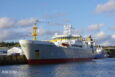
For the following day, 8 May 2026, sees the christening of a brand-new Dutch factory ship: the Annie Hillina (112 metres long, capable of catching and processing 400 tonnes of fish per day), commissioned by the multinational Parlevliet & Van der Plas: one of the ‘Big Five’, which also owns the Annelies Ilena, the world’s largest trawler (145 m), which you know well given how long we have been fighting against it.
8 May 2026: christening of a new sea OGRE in IJmuiden, the Netherlands
On 8 May, we are on site at the industrial port of IJmuiden in the Netherlands to take part in a demonstration. The response is unprecedented, and political support soon follows:
- On 14 May, Xavier Bertrand (Les Républicains), President of the Hauts-de-France region, writes to the Minister.
- On 19 May, MEP Emma Fourreau (The Left/LFI) tables an amendment in the European Parliament to ban vessels over 25 metres from entering the 12-mile zone. The amendment is rejected, but the vote at least provides clarity: MEPs Stéphanie Yon-Courtin (Renew) – who is otherwise quick to show her support for fishers – Isabelle Le Callennec and François-Xavier Bellamy (Les Républicains),) abstain. The Socialist Éric Sargiacomo, votes against French fishers and in favour of Dutch industrialists!
We’ll leave you to judge the betrayal by these French elected representatives for yourselves.
1 June 2026: scientists PUSH the debate FORWARD
On 1 June, science provides quantified evidence to inform the debate. A report by researchers at the Institut Agro measures, for the first time, the impact of industrial vessels on our coasts. They show that 45% of the catch in the coastal waters of Hauts-de-France is taken by vessels over 24 metres in length (13% in Normandy). Yet vessels under 12 metres in length account for 95% of their catches in these waters.
The conclusion is clear: the coastal zone is vital for small-scale fishers, and it is under threat from these destructive giants.
A few days later, Philippe Fait (Horizons), French MP for Pas-de-Calais, calls on the Minister in the French National Assembly to make use of existing legal instruments: Article 20 of the CFP (Common Fisheries Policy), which allows an EU Member State to take measures to protect its waters provided it ‘notifies’ the European Commission and the other Member States concerned of the procedure.
18 June 2026: Minister Catherine Chabaud pledges to ban industrial fishing vessels!
Faced with pressure from politicians, fishers and NGOs, led by BLOOM, Minister Catherine Chabaud finally makes a public commitment at the Fisheries Conference on 18 June in Cherbourg. If fishers request it, she said, she would launch the consultation with Member States provided for under Article 20 of the Common Fisheries Policy, to exclude vessels over 25 metres from the coastal zone.
A real political turning point, at last!
In the wake of this, the situation is shifting: Stéphanie Yon-Courtin (Renew) regroups and, together with 16 French MPs and senators from Normandy, asks the minister to launch the consultation as soon as possible. Members of French Parliament, including Philippe Fait, table a motion at the Pas-de-Calais Departmental Council.
Summer 2026: Catherine Chabaud is playing for time…
Despite the perfect opportunity to finally take concrete action to defend both fishers and the ocean in one fell swoop, the minister is dithering. She says she is waiting for the conclusions of a ‘consultation mission on the English Channel’ (the Gatto mission) launched in early 2026.
The summer drags on, with no news, then events begin to unfold rapidly.
On 2 September 2026, the report of the ‘Gatto mission’ is submitted to the Minister. At first glance, it appears to advocate the exclusion of vessels over 25 metres in length, but it is impossible to verify this as, to date, it has still not been made public: it has not even been shared with fishers or their representatives. By the time this much-discussed report is made public (if it ever is), it will most likely have been stripped of all elements clearly in favour of a ban on industrial vessels within 12 nautical miles.
This is yet another scandal, but there are so many to cover in a single update that we will just stick to the essentials: the historic vote on 7 September.
7 September 2026: ‘House of Cards’ at the French National Fisheries Committee
On 7 September, members of the ‘English Channel-North Sea’ subcommittee of the National Fisheries Committee experienced an episode worthy of the famous American series ‘House of Cards’, which depicts all the underhand and vicious manoeuvres of the political world.
In the run-up to a crucial vote determining the National Fisheries Committee’s official position on banning vessels over 25 metres from coastal waters, the lobbyists tried EVERYTHING to derail the vote. They rallied the cream of the crop of industrial fishing representatives; they turned up in droves; they demanded a secret ballot…but they failed: the defenders of small-scale fishing won.
Democracy, though under pressure within the Committee, has ultimately prevailed. From now on, the body representing French fishers is officially in favour of banning industrial vessels within 12 nautical miles. According to Dimitri Rogoff, chairman of the Normandy Regional Fisheries Committee, 99% of fishers surveyed, from Normandy to Hauts-de-France, support the ban. This vote therefore reflects nothing other than an absolute consensus within the industry, barring the interests of the 1% of industrial operators.
Minister Catherine Chabaud had only to keep her promise and initiate the European procedure to exclude these vessels.
But…
Catherine Chabaud backs down
The minister who claimed to be ‘in love’ with the sea and a staunch defender of French fisheries, and who had publicly pledged to ban vessels over 25 metres from coastal waters if that was what the fishers wanted (though, one might also wonder, if the aim is to protect the most fragile coastal ecosystems, why take orders from the fishers in the first place?)… finally gives up on protecting the ocean and the fishers.
She told us so herself on 15 September.
We had organised a demonstration in Brest, where the minister was due to visit, to call her to account. Citizens, fishers, seafarers from the CGT du Grand Ouest, organisations (Pleine Mer, Mor Glaz, Greenpeace, Force 5), oceanography students and local councillors: everyone was there to await the minister’s arrival.
And we secured a brief meeting with Catherine Chabaud. About ten minutes. Long enough for the minister to admit… that she was giving up.
In essence, she told us: “It’s not possible. Not now. I’m frustrated. The lobbies are too powerful. It’s beyond my control.”
And she dared to cross the Rubicon.
She dared to spout a lie: “We need more science.”
Experts say there is “nothing left” in the waters of the English Channel, yet the minister has adopted this lamentable and ultimately disingenuous argument put forward by the industrial lobbies.
And she didn’t stop there.
She added, in response to BLOOM: “You’re just like any other lobby group.”
Things have gone completely off the rails. The minister pretends she can no longer tell the difference between the capitalist Goliath – the oligarchs ready to corrupt democratic processes with their lies and threats – and the tiny David that is a scientific organisation fighting with whatever means it has at its disposal, alongside valiant citizens (to whom we are eternally grateful), to prevent the world from collapse.
Let’s move beyond the minister who’s out-of-touch
Let’s leave the minister to her guilty conscience and move up a level: to the French Prime Minister. For time is running out: by delaying the initiation of the European procedure to ban the vessels, the government is effectively ensuring that Dutch mega-trawlers will be able to return to the waters of the English Channel in mid-November.
This is quite simply unacceptable.
Today, the lines are crystal clear, and the divide is stark: on one side, science, fishers, NGOs and the public. On the other: 1% of mega-industrial vessels, backed by Dutch multinationals prepared to do anything to defend their privileges – privileges that the State has allowed them to build up over decades of collusion.
And finally, Catherine Chabaud makes a decision!
We stood firm right until the very end; we must stand up for the interests of small-scale fishers, who have so often been crushed in the past.
… and now, at last, during her press conference on 22 October, the Minister officially announces that the consultation has been launched. The path has now been laid for the end of large vessels off the coasts of the English Channel and the North Sea.
And it is about time, given that the famous Gatto report tells us that the presence of large vessels off these coasts has risen by 72%, and that their number has almost doubled between 2019 and 2025, rising from 37 to 70. But how many of them fly the French flag? Four or five at most, according to the Ministry.
If we choose to see the ocean as half empty, we will lament all that time wasted and handed over to the giants of the seas who are destroying everything, starting with the French fishing industry. But if we choose to see it as still half full, we can shout: VICTORY!
NOTES
[1] https://www.bloomassociation.org/en/the-33-metre-measure-bloom-calls-for-the-scrapping-of-vessels-over-33-metres-in-length-to-put-an-end-to-mega-industrial-devastation/